
Find the latest job offers from the SiNANO members (PhD, internship, post-doc, position…).

ICN2 is seeking a Junior Research Group Leader with an outstanding record in nanoscience and nanotechnology. The successful candidate will establish an independent research program within the vibrant intellectual environment of ICN2. The program should be focused on optical and optoelectronic measurements of advanced quantum materials and devices, with potential applications in photodetection, sensing, communication, or computing. Relevant research areas include quantum photonics, moiré and topological physics, and many-body physics in quantum materials.
The Junior Research Group Leader will have full principal investigator rights, will be provided with a startup package and dedicated laboratory and office spaces and will count with the administrative and technical support of the ICN2 staff.
Candidates should have received their PhD after January 1st 2018 and should demonstrate a track record and research vision that would make them competitive for top-tier early-career funding schemes (e.g., ERC Starting or Consolidator Grants or Ramón y Cajal fellowships). International mobility experience is required.
Summary of conditions:
• Full time work (37,5h/week)
• Contract Length: 5-year
• Location: Bellaterra (Barcelona)
• Salary will depend on qualifications and demonstrated experience.
• Support to the relocation issues.
• Life Insurance
Details and applications: here
Deadline for application: April/May 2026

Uppsala University (sweden) is recruiting a PhD student in Neuromorphic Devices and Circuits for Next-generation Sensing and Computing.
- hold a Master’s (second-cycle) degree in electronics (electronic science/engineering), electrical engineering, (applied/engineering) physics, or in a similar field, or
- have completed at least 240 credits in higher education with at least 60 credits at Master’s level including an independent project worth at least 15 credits, or
- have acquired substantially equivalent knowledge in some other way.
- interest in developing neuromorphic devices, circuits and systems, including both hardware implementations and computational models,
- very good study results.
For details and to apply, click here
Read more about what it is like to work at Uppsala University.
Last application date: 2026-02-25


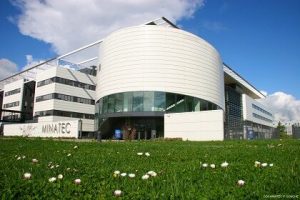 Minatec – CROMA